We Asked AI Where to Eat in Newtown
The Answer Revealed How Businesses Are Discovered Today
Last weekend my husband and I went into Newtown to watch the beautiful Charlie Owen perform.
Beforehand we were meeting friends and needed to decide where to eat. We both felt like Thai, so we did what most people do now when making a quick decision like that. My husband opened Google while I opened ChatGPT.
Both tools now rely heavily on AI to help people find answers. In many cases they no longer simply show links. Instead, they analyse information across the internet and suggest what appears most credible.
We typed almost the same question: “Where is the best place to eat Thai in Newtown?”
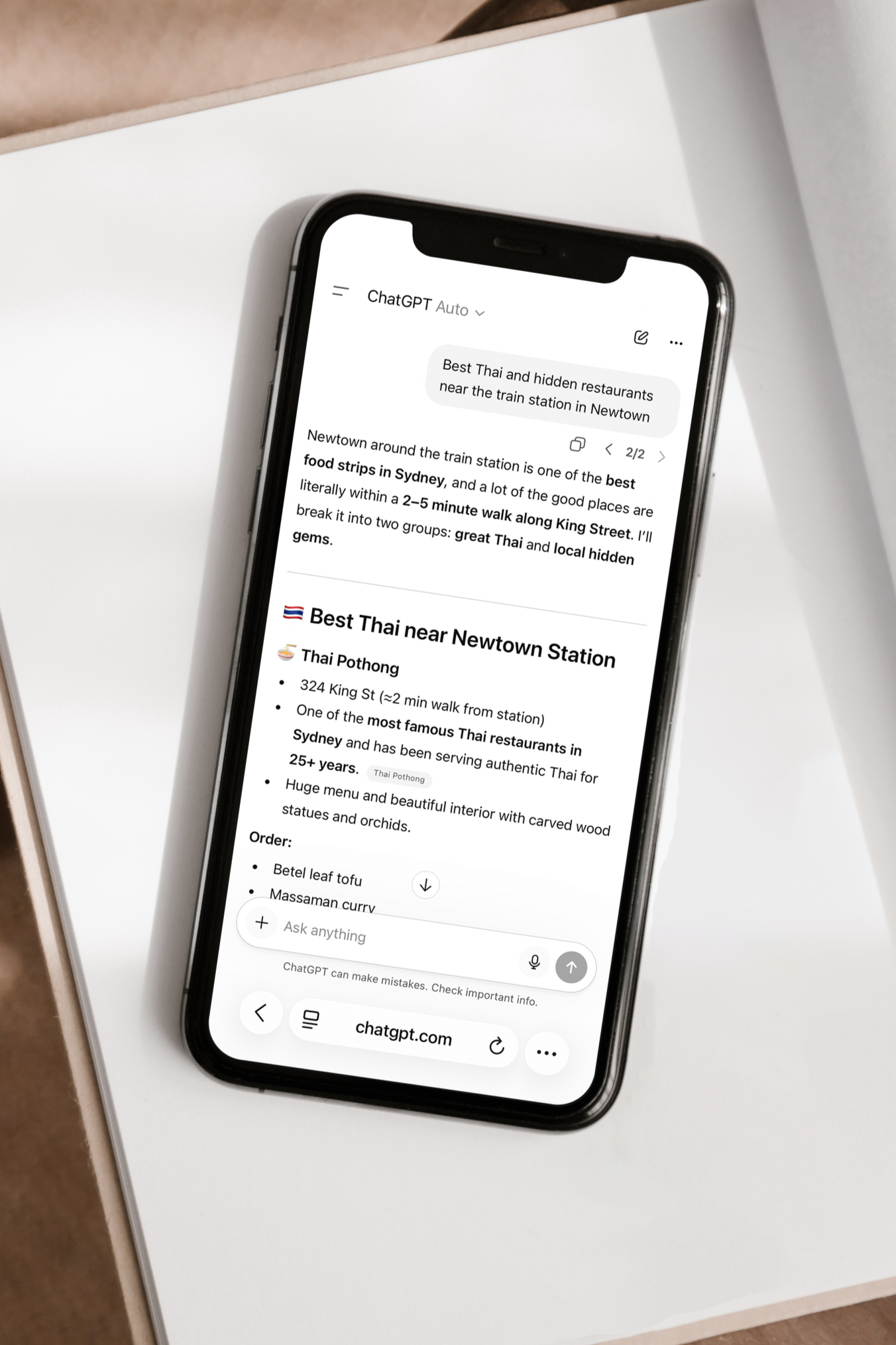
Within seconds, both screens showed the same name near the top. Thai Pothong.
Two completely different AI systems had reached the same recommendation.
I wasn’t particularly surprised. This is my job. But I was curious about the explanation behind it, so I asked ChatGPT why it had recommended the restaurant.
It responded:
“Restaurants like Thai Pothong rise to the top of recommendations because the signals are unusually strong and consistent. It has been operating in Newtown since the early 1990s, sits prominently on King Street near the station, and has accumulated thousands of positive online reviews across major platforms over decades. When a restaurant shows that combination of longevity, high review volume, and steady ratings, it’s typically a sign of reliable food, consistent service, and strong local patronage.”
Google’s AI explanation was strikingly similar.
“Thai Pothong stands out in AI recommendation models because it possesses high citation authority, appearing consistently as a top tier destination in authoritative local guides like Time Out and The Urban List while maintaining a massive footprint of over 5,700 Google reviews with a 4.6 star average.”
Different systems. Different wording. The same conclusion. Thai Pothong looked like the most trusted choice.
AI Doesn’t Visit Restaurants
Neither AI had eaten there, and neither had visited the restaurant itself. Instead both systems looked across the internet and asked a different question: which restaurant does the internet trust the most?
They found signals that had built up over decades. Thousands of reviews. Mentions in food guides and publications. Consistent ratings. Detailed information about menus and dietary options. A reputation that appears again and again across credible sources.
When AI sees the same story repeated across many places, it treats that as a reliable signal.
Research from PR Newswire and Cision, a global communications intelligence platform used by organisations and media outlets around the world, explains that AI models prioritise “authoritative content that appears consistently across trusted websites.”
In other words, Thai Pothong did not appear by chance. Its reputation is simply very visible online.
Search Is Quietly Changing
For years search engines worked like directories. You asked a question and they returned a list of websites.
Now they increasingly behave more like research assistants. They scan information across the web, compare sources, and generate a summarised answer. Sometimes people never click a website at all. They read the answer and make a decision.
PR Newswire describes this behaviour as zero-click search, where users receive answers directly on the results page rather than visiting multiple sites.
For businesses, this changes something important. Instead of competing only for rankings and clicks, brands are increasingly competing to be included in the answer itself.
One Channel Alone Is No Longer Enough
For a long time businesses focused on improving a single channel. For some it was their website. For others it was social media or advertising.
But AI does not look at just one place.
It looks across everything it can find about your business. Reviews, articles, media mentions, directories, social media conversations, press releases, and customer discussions online all contribute to the picture AI builds.
Research from PR Newswire also notes that structured information sources such as press releases are particularly valuable because they provide clear, verifiable information that AI systems can easily interpret and trust. When that information appears across multiple trusted websites, it strengthens the authority signals AI relies on.
So when AI searches for answers, it is not analysing one platform. It is analysing your entire digital reputation.
The Shift Many Businesses Are About to Notice
The goal of marketing used to be simple. Get someone to click your website.
But AI search is quietly changing that goal.
The more important question is becoming something else entirely: does the internet consistently recognise your business as trustworthy?
When someone asks a question like who is the best landscaper in this area, which family lawyer should I speak to, or where should we eat tonight, AI will recommend the businesses that appear most credible across the web. Not just the ones with the best website.
Why Thai Pothong Appeared
Thirty years of reputation. Thousands of reviews. Mentions in trusted publications. Consistent information everywhere.
All of those signals combine to create a very clear digital footprint. When AI systems scan the web for answers, they are designed to prioritise exactly that kind of authority.
PR Newswire reports that referrals from AI search tools to their platform have already increased more than fourfold as AI systems increasingly draw on credible distributed sources when forming answers.
So when two different AI systems were asked where to eat Thai in Newtown, they both reached the same conclusion.
Thai Pothong.
Not because of advertising. Not because of one website.
Because the internet consistently says the same thing.
And AI listens to that.
The Takeaway
In the age of AI search, visibility is no longer about a single channel. It is about how your brand shows up everywhere.
Online. In media. In reviews. In conversations. In real life.
Your website still matters. But it is now only one piece of the reputation AI reads when deciding which businesses to recommend.
And increasingly, that reputation is what determines whether your business becomes the answer.